
Alive and cyclic momentum
Humans are the only living organisms that need a purpose. A purpose is an intention and a reason to live for the future. Humans live in the current moment for the future. All other living organisms live at the current moment. They have no intention and no reason to live. They are simply alive. Alive continues without intention or reason. Alive doesn’t need the cognition of the future.
Alive is cyclic momentum. Imagine a tire rolling down a hill. Rolling creates the forward momentum. The tire has no intention of moving or reaching anywhere. Its shape and its hilly environment, with gravity, accidentally create cyclic momentum and forward momentum. This is not a purpose. But happens. This is not an intention. The interaction of two geometrical properties, the shape of a tire and the shape of the landscape.
The forward momentum has a direction. This direction appears to be an intention and a purpose. However, it doesn’t need to be. Without cyclic momentum, there is no forward momentum. When the cyclic momentum stops, the forward momentum will stop. The speed of forward momentum varies. The straightness varies but is associated with speed.
When the first rolling happens, there is a chance of a second rolling. Without the first rolling, no chance of forward movement. A tire and a hill (i.e. two geometrical properties) are necessary but not sufficient to see this.
Something rolling doesn’t need to be a tire. Anything roll can do the same thing. A ball can roll. Something spherical, a circular disc or a cylinder. The surface smoothness helps, but it is not an absolute requirement. Think of snowballs. If the first roll occurs, subsequent rolls will trim its shape. Once cyclic momentum is initiated, this cyclic momentum modifies its shape.
Initiation of cyclic momentum does not guarantee the continuous forward movement. The ones who continue to move forward keep rolling. The shape of rolling one’s coverage to a cyclic disc.
No intention in forward momentum. Cyclic momentum is the consequence of its own shape and landscape. When the land scape change, the momentum may stop.
Living organisms are a tire on a hill. Cyclic momentum of biochemical reactions produces the momentum of reproduction in its local environment.
Because of no cognition of the future, all living organisms have no anxiety, except for humans. No anticipation and no disappointment. All these emotions come from predictions and expectations of the future, not from the event in the present moment. Cognitive emotions.
Fears (and anger is a response to fears) are emotions to the event in the present moment. Some animals, like dogs, can develop some cognitive emotions through living with humans, due to the highly repetitive nature of the human lifestyle. Except for humans and some domesticated animals, the ability for cognitive emotions does not exist or is minimal.
In other words, the state of being alive in living organisms is a momentum. This momentum is maintained based on its shape and its local landscape (i.e. environment). No intention nor purpose.
This cyclic momentum includes reproduction. One becomes two or more in each cycle. One cycle has rolled in its local environment. Then, the chance of the second cycle. The success of rolling is probabilistic. This probability depends on the shape and properties of a rolling entity and the condition of the landscape, such as steepness, smoothness, hardness, stickiness and so on.
Whatever the success frequency, the chance of the second cycle is. The probability of successful cycling can be 100%, 50% or even lower. As a whole, if anything keeps rolling in its environment is probabilistic. It is determined by the number of opportunities for trials and the probability of successful cycling.
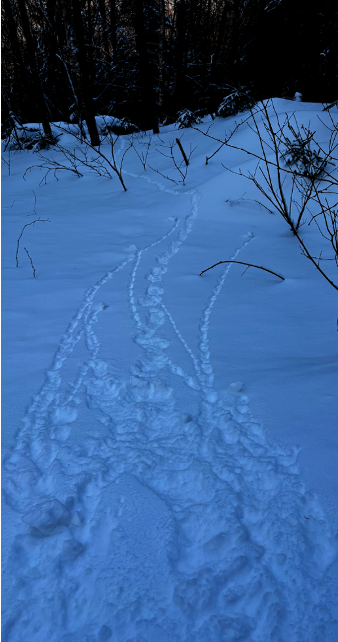
I found the best analogical phenomenon to convey my view. I was hiking a snowy mountain in winter. Everything was covered by snow. Some areas had fresh snow, while others had a bit of hardened surface snow from sunlight. Flat and hilly zones. Many trees are without leaves. Branches of evergreen trees were covered by snow. Winds shook the branches. The snow on them fell. Under certain snow conditions with a steep slope, the fallen snow triggered snowball rolling. This doesn’t occur on fresh snow. The snow surface needs to be a bit hardened. The falling snow also needs a bit of cohesion. Fresh powder snow cannot initiate a snowball. To initiate snowball rolling, it needs to be a clump of snow. Sphericity is not of absolute importance. Rolling momentum trims the shape. Sometimes, the rotation axis changes.
No intention in snow, wind, or steep slope. Snowballs had no plan for where they go. Some snow clumps did not initiate rolling. When rolled once, they went a few more. Some kept rolling quite far and then stopped. On one rare occasion, one snowball kept rolling beyond our sight.
This looked like the beginning of life to me. The accidental generation of cyclic momentum in the local environment. This cyclic momentum produces forward momentum. The success of continuous cyclic momentum is probabilistic. The balance of reproduction and death as a group.
The emergence of cyclic momentum in its local environment. Reproduction and the probabilistic success of cyclic momentum in the reproduced population. Nothing is intentional. Nothing is purposeful. Biochemical reaction. Biophysical self-organization. Probabilistic success of sequential cyclic events. The local environment provides enough opportunities. The size of the population will be determined by the equilibrium between probabilistic success and opportunity frequency (i.e., density).
No goal. Cyclic momentum has been continued and will continue. No meaning. No purpose.
On the other hand, I agree that a purpose is important for a human life. It is difficult to conceive that our lives are meaningless, purposeless, or goalless. Because we have built our cognitive societies based on our ability to use language. Humans conceive time, the existence of the past and the future. Recognition of the time and recognition of repetitive events bring anxiety, anticipation and prediction to the future. We cook. We make and carry tools. We build. We store. On the other hand, these abilities make us prone to uncertainty. The development of human societies is the history of controlling the future through predictions and eliminating uncertainty.
The best way to eliminate uncertainty is to exclude others (i.e. not limited to other humans) to minimize the opportunities for accidental encounters. However, we also know, particularly those who live close to nature, that natural disasters can go beyond our predictions. Those people never lose a sense of awe for nature. After all, humans cannot exist without nature, our surrounding environment.
In the human cognitive world, purposes, goals and intentions exist. They help minimize anxiety about the future. They help accept the uncertainty of the real world. They give us the direction.
But don’t let the direction dictate to you. Alive is the default and consequential, like rolling snowballs. The momentum is given. Alive is given. Alive alone should fulfill ourselves.
Comments